Showing posts with label Atlantic Ocean. Show all posts

Tuesday, June 14, 2016

Canadian Adventurer To Row Across the Atlantic Solo

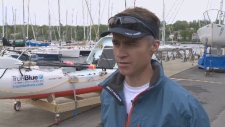
A Canadian adventurer who was the first person from that country to summit Everest without the use of oxygen is now preparing to embark on his next big challenge – a 4500 km (2796 mile) solo crossing of the Atlantic Ocean to raise funds to fight cancer.

This month, Laval St. Germain will set out from Halifax Habor on what he calls the Confront Cancer Ocean Row. His hope is to arrive in France in a few months time, braving big waves, hundreds of miles of open water, and potentially dangerous storms along the way. Traveling west to east across the turbulent North Atlantic will test his stamina and determination with cold water and icy seas as well.

St. Germain is making this solo Atlantic crossing to raise funds for the Alberta Cancer Foundation. He hope to pull in $200,000 in donations to help support that organizations cause, which is to work towards the cause of curing cancer and bringing an end to the disease which 43 Albertans are diagnosed with on a daily basis.

But Laval has another inspiration for rowing across the Atlantic too. In July of 2014, his oldest son drowned in a canoe accident on the Mackenzie River in the Northwest Territory of Canada. He was 21-years old at the time, and had been attempting to lend assistance to a girl who was panicking while swimming in those waters. The young man lost his life, which as you can imagine had a dramatic impact on his family's life.

According to his Twitter feed, Laval will launch his epic crossing starting tomorrow – Wednesday, June 15. His specially designed rowboat has been placed in the water, and has been stocked with supplies, and the weather looks good for the start of the journey.

If you want to follow this adventure as it unfolds, it looks like Laval's Twitter is the best way to go. I wish him godspeed on this expedition. It should be a challenge unlike any other.

Monday, June 6, 2016

Aleksander Doba Abandons Third Atlantic Crossing

In April of this year I told you that Polish long distance kayaker Aleksander Doba was planning to attempt a third crossing of the Atlantic Ocean under his own power at the age of 69. His plans were to set out in late May on a voyage that was expected to take four or five months to complete. Unfortunately, those plans came to an abrupt end just a few days after he set out thanks to unexpectedly powerful waves that capsized his boat.

According to ExWeb, Doba set out on May 31 after waiting for forecast of good weather. But a few days later on June 2, he ran into trouble. A small (1 meter) – but powerful – wave hit Aleksander's kayak, tipping it over not once, but twice. The wave caused damage to the boat, which caused Doba to abandon the crossing, and head back to shore.

Once back on dry land it was determined that the damage done to the kayak was too much to repair and relaunch the Atlantic crossing. Aleksander had hoped he could be back on the water within a couple of days, but it soon became evident that his boat would require repairs that would take an extended amount of time, closing the window on paddling from the U.S. to Portugal this year.

This would have been Doba's third Atlantic crossing, but the first to go west to east. His most recent crossing was completed in 2014, when he paddled more than 7716 mile (12,417 km), starting in Portugal and ending in Florida. That was enough to earn him recognition as a National Geographic Adventurer of the Year, and recognition for what is possible even at an older age.

Aleksander had hoped to celebrate his 70th birthday in Portugal this year following his epic paddle. Now, he'll delay his third Atlantic crossing until next year, when he'll give it another go. Hopefully that expedition will be more successful.

Saturday, August 30, 2014

Warming waters threaten to trigger methane eruptions from Arctic Ocean seafloor


K. Tung / Univ. of Washington. (Top) Global
average surface temperatures, where black dots
are yearly averages. Two flat periods (hiatus)
are separated by rapid warming from 1976-1999.
(Middle) Observations of heat content, compared
to the average, in the north Atlantic Ocean.
(Bottom) Salinity of the seawater in the same
part of the Atlantic. Higher salinity is seen
to coincide with more ocean heat storage.
A new study looks at how, in the 21st century, surface warming slowed as more heat moved deeper into the oceans, specifically the North Atlantic.

Sun-warmed salty water travels north along ocean currents in the Atlantic. When this saltier water reaches the North Atlantic, its greater density causes it to sink. From about 1999, this current began to speed up and draw heat deeper into the ocean.

These huge amounts of heat moving deeper into the Atlantic Ocean are very worrying.

The image below shows that sea surface temperatures have reached extremely high levels on the Northern Hemisphere, where sea surface temperature anomalies as high as 1.78 degrees Celsius were recorded on August 19, 2014.

As discussed in an earlier post, water carried by the Gulf Stream below the surface can be even warmer than surface waters. As the post discusses, high sea surface temperatures west of Svalbard indicate that the Gulf Stream can carry very warm water (warmer than 16°C) at greater depths and is pushing this underneath the sea ice north of Svalbard. Similarly, warm water from greater depth comes to the surface where the Gulf Stream pushes it against the west coast of Novaya Zemlya.


Very warm water is now invading the Arctic Ocean through the Bering Strait from the Pacific Ocean, while very warm water is also traveling on the back of the Gulf Stream from the North Atlantic into the Arctic Ocean.


The danger is that this warm water will destabilize hydrates contained in sediments under the Arctic Ocean and trigger huge methane eruptions.

Rising methane levels over the past few years are ominous in this respect. The image below shows very high mean global methane levels on August 28, 2014, while methane readings as high as 2561 ppb were recorded on that day.

Methane Levels -  see earlier post for a discussion of IPCC/NOAA data

In conclusion, the situation is dire and calls for comprehensive and effective action, as discussed at the Climate Plan blog.


References and Related Links

- Varying planetary heat sink led to global-warming slowdown and acceleration
by Xianyao Chen and Ka-Kit Tung.
http://www.sciencemag.org/content/345/6199/897

- Cause of global warming hiatus found deep in the Atlantic Ocean
University of Washington News Release
http://www.washington.edu/news/2014/08/21/cause-of-global-warming-hiatus-found-deep-in-the-atlantic-ocean

- Horrific Methane Eruptions in East Siberian Sea
http://arctic-news.blogspot.com/2014/08/horrific-methane-eruptions-in-east-siberian-sea.html

- Methane Buildup in the Atmosphere
http://arctic-news.blogspot.com/2014/04/methane-buildup-in-atmosphere.html

- Climate Plan blog
http://climateplan.blogspot.com