Showing posts with label Arctic Ocean. Show all posts

Thursday, June 16, 2016

British Adventurers to Paddle From Greenland to Scotland


Two British adventurers are preparing to set out on a challenging kayaking expedition that will take them across the Arctic Ocean and North Sea as they travel from Greenland to Scotland. Their journey is set to begin this Sunday and is expected to take upwards of six weeks to complete.

In just a few days time, Olly Hicks and George Bullard will leave the U.K. for Greenland where they will launch their In the Wake of the Finnmen expedition. This journey by sea will cover more than 1200 miles (1931 km) as they travel from the Denmark Strait to Iceland, follow the coastline of that country before daring the waters of the North Sea to head towards the Faroe Islands, a remote place located north of the British Isles. After that, they'll turn south to paddle 50 miles (80 km) to reach the tiny island of North Rona before pressing on with the final leg, which ends at Cape Wrath in Scotland.

All told, the two men expect to be padding for six weeks, with 12 nights actually spend out on the water in the open seas. The first three of those nights will take place on the crossing from Greenland to Iceland. The paddlers will then take their time kayaking along the shores of that country, regaining their strength and preparing for the challenges ahead. During that section of the expedition they'll cover about 20 miles (32 km) per day before pushing on to the Faroe Islands, which will force them to spend another six nights at sea. The final three nights will be when they make the final push across the North Sea to Cape Wrath. 

Olly and George will be paddling a modified Inuk Duo 6.8m sea kayak, which is designed to withstand the challenges and rigors of open water in remote seas. It has also been made for long distance paddling expeditions, with plenty of storage for gear and supplies. The kayak even has sealable cockpits, allowing the men to squeeze inside its hull to catch some sleep on those long nights at sea. 

The aim of the expedition is to prove that the Inuit people of the Arctic could have made a similar journey to populate island that are found in the Atlantic and Arctic Oceans. Hicks has called it the “Arctic Kon-Tiki expedition" in a nod to the famous Thor Heyerdahl expedition from 1947. Olly and George's boat is much smaller than Heyerdahl's however, with some very different challenges. 

This won't be be the first waterborne journey for Hicks. Back in 2005 he became the youngest person to row solo across the Atlantic Ocean at the age of 23. In 2008, we followed his attempt to row around Antarctica as well, and while other expeditions have taken him across the Tasman Sea and around Great Britain. In the future, he hopes to row around the world, taking another crack at the Southern Ocean off the coast of Antarctica once again. 

Tuesday, May 31, 2016

Japanese Polar Explorer Yasu Ogita Completes Canada to Greenland Expedition

Way back in March I told you about Japanese polar explorer Yasunaga Ogita's plans to ski from northern Canada to Greenland across the frozen sea ice of the Arctic Ocean. At the time, he was just preparing to set out, but now, two months later, he's finished the journey at long last, covering more than 830 km (515 miles) in the process.

Yasu initially set out from Grise Fjord on Ellesmere Island back on March 30. He then spent the next 48 days skiing to Greenland, crossing the frozen expanse of the Arctic Ocean along the way. He told ExWeb that his biggest challenge while en route was the fast moving arctic ice that was pushed along by a strong current. Crossing those moving floes can be difficult unless you're traveling at high speed, which isn't possible on foot when dragging a heavy sled behind.

Along the way, the Japanese polar veteran also encountered plenty of polar bears and even an arctic wolf who took an interest in his travels. He also saw seals, musk ox, caribou, and other creatures as well, proving that this part of the world isn't quite so empty as some would think.

To prepare for the crossing Yasu spoke to other explorers who had traveled in the region before, as well as locals in both Canada and Greenland. But much of the path was completely unknown, with very few people ever crossing through this part of the world. The crossing isn't completely unknown, but it is a very rare occurrence to say the least.

Yeas wrapped up his journey on May 16 and just recently traveled home to Japan. He is no doubt already thinking about his next adventure.

Monday, May 9, 2016

Russian Teens Skied to the North Pole in Just 5 Days

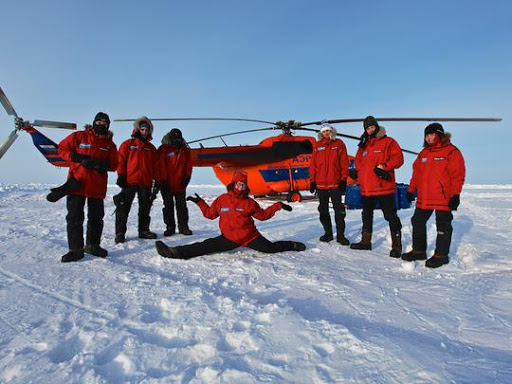
The 2016 Arctic Season may be over, but there are still a few interesting stories to share. For instance, ExWeb has posted an article about a team of Russian teens who skied to the North Pole (last degree) in just 5 days following a host of delays that cut into their planned time out on the ice.

The group of seven teens had planned to make a last-degree ski expedition to the North Pole via the Barneo Ice Camp. Their original schedule gave them 7-10 days to complete the journey, which covered roughly 125 km (77.6 miles) over the frozen Arctic Ocean. That means they were able to sustain a pace of about 25 km (15.5 miles) per day, which is an excellent pace considering the conditions they encountered on the ice.

The challenges of the Barneo Ice Camp have been well documented on this blog, and elsewhere, this year. The ice flows that the temporary base is built on were being buffeted by ocean currents throughout the season, causing the blue ice runway there to crack multiple times. That caused a lot of delays, causing the Russian teens, and a number of other teams, to back up while they waited for their chance to fly out to the camp. Eventually the runway was completed, and the flights started arriving, but it took awhile to catch up on the backlog of people who were waiting to arrive in the Arctic. This cut into the time that the skiers had to reach the Pole.

According to ExWeb, when the team was retrieved from their finish line at 90ºN, they did not look tired or exhausted. In fact, they still had a lot of energy and were so excited to have reached the North Pole. It was quite a journey for these young adventurers, many of whom have wanted to ski through the Arctic for the better part of their lives.

I know that this is "only" a last degree ski expedition, but it is still an impressive feat to see these teenagers make that journey in such a quick pace. Five days to cover a degree of latitude is quite a short time frame, and I know a few polar explorers who would be hard pressed to maintain that same pace themselves. Also, how cool is it to be a teenager and get to go to the North Pole. I clearly went to the wrong high school.

Thursday, May 5, 2016

Barneo Ice Camp Closes for 2016

The 2016 Arctic exploration season came to an end last week when the Barneo Ice Camp closed for another season. The temporary ice base is built on an ice flow in the Arctic Ocean each year, and for several weeks it serves as the launching point for various expeditions, research teams, and well-heeled adventure travelers to travel to the North Pole or explore the region. This year it was clear that the Arctic continues to be a place in transition, with the future of travel there seeming more difficult than ever.

For the second year in a row there were now full-distance skiers to the North Pole. The logistics of such an expedition seems to be getting more challenging with each passing year, and climate change is making that journey more difficult than ever. I've said before that the toughest expedition on the planet is skiing to the North Pole, and we may actually have seen the last team to do that a few years back. Others have announced plans to attempt that journey, but no one has been able to duplicate it. That was the case this season as well with the Race Against Time squad, and I think it will probably be the same for future teams too.

2016 was a difficult year for the team that builds and operates the Barneo base as well. Not only did they have problems building and maintaining the ice runway there, they also ran into issues dealing with the Norwegian government too. The challenges with the runway were the result of the Arctic Ocean churning the increasingly thinning ice there, causing the landing strip to crack. Those problems aren't going away, and will probably continue to get worse in the years ahead.

The Barneo team has announced that they'll avoid traveling through Svalbard in Norway moving forward, and will instead use Franz Josef Land for their logistics starting in 2017. The friction with the Norwegians began when a reporter claimed that a team of Ukrainian commandos passed through Norway on their way to Barneo – something the Barneo staff denies – which calls into question whether or not the flights from Svalbard to the ice camp posed a security threat. As a result, the Norwegian government put new restrictions on the Barneo flights, which ultimately forced the change of direction for future seasons.

The 2016 Arctic season was reasonably successful with marathon runners, researchers, explorers, adventure travelers, and more passing through Barneo. Now, it'll be another year before we'll see if anyone can make the journey to the North Pole again. Good luck to the explorers aiming for that feat in 2017.

Monday, October 6, 2014

Wild Weather Swings


Above combination-image illustrates some of the wild temperature swings that are taking place on the Northern Hemisphere. While the average temperature anomaly on the Northern Hemisphere may not differ much between the two dates (+0.95°C versus +1.07°C), huge temperature swings can occur locally, as is the case in Greenland.

Note that the overall temperature anomaly for the Arctic is +2.16°C and +3.34°C, respectively, but it can be much more locally. What contributes to these high temperatures in the Arctic is that heat from the Arctic Ocean is entering the atmosphere where there still is open water, while large emissions of methane from the seafloor of the Arctic Ocean are exercizing their high immediate local warming potential.

On the Southern Hemisphere, things aren't much different, as illustrated by the combination-image below.


The two images show that, while the average anomaly for the Southern Hemisphere and for the Antarctic may not differ much between the two dates, temperature anomalies locally may go from one end of the scale to the other.

And it's not merely temperatures that seem to have gone wild. Winds have strengthened, which can push sea ice far out into the sea surrounding Antarctica, while the resulting open water quickly freezes over. The result is expanding sea ice that traps heat in the ocean, as discussed in an earlier post. It appears that much of the extra energy trapped by greenhouse gasses becomes manifest as kinetic energy, in the form of stronger winds, storms and ocean currents.

In conclusion, these huge temperature swings combine with pressure swings and storms, and with swings between expansion and contraction of soil and ice, resulting in severe shocks to ecosystems and infrastructure.

The threat is that infrastructure will increasingly come under stress. Infrastructure that was built up over hundreds, if not thousands of years, is not easily replaced with more durable alternatives. Parts of infrastructure such as roads, buildings, railways, storm water and drainage systems, water supply, dams, levees and power poles may collapse without much scope for repair.

Furthermore, soil degradation will increase, as in some areas storms grow stronger and run-off causes more erosion, while other areas may be hit by more severe droughts and dust-storms. In both cases, ecosystems will suffer and can go into shock, bringing food supply and habitat progressively and possibly abruptly under threat.

As more and deeper cracks and fractures appear in sediments and soils, more methane may start entering the atmosphere. Indications that the integrity of the permafrost is breaking up under the stress of such swings were discussed in earlier posts such as this one and this one. The extra methane can constitute a powerful additional feedback loop, causing strong additional warming locally.

The situation is dire and calls for comprehensive and effective action, as discussed at the Climate Plan blog.


References and Related Posts


- Climate Plan
http://arctic-news.blogspot.com/2014/07/climate-plan.html

- Antarctica linked to Arctic
http://arctic-news.blogspot.com/2014/09/antarctica-linked-to-arctic.html

- What's wrong with the weather?
http://arctic-news.blogspot.com/2014/07/whats-wrong-with-the-weather.html

- Is Global Warming breaking up the Integrity of the Permafrost?
http://methane-hydrates.blogspot.com/2013/05/is-global-warming-breaking-up-the-integrity-of-the-permafrost.html

- Earthquakes in the Arctic Ocean
http://arctic-news.blogspot.com/2014/04/earthquakes-in-the-arctic-ocean.html

- Ten Dangers of Global Warming (written March, 2007)
http://samcarana.blogspot.com/2007/03/ten-dangers-of-global-warming.html


Thursday, September 18, 2014

Warm water flowing into Arctic Ocean

by Harold Hensel

For the first time in thousands of years, warm water is flowing into the Arctic Ocean. Warm water from the deep ocean is showing up on surface images. There is no way to put this into the context of 'normal.' Historic temperatures have kept the Arctic frozen on an even keel for thousands of years. Even if there was a 'natural cycle' it has been completely overridden by the astonishing amount of pollution that is going into the atmosphere.


Over 90 percent of Earth's energy imbalance has been going into the oceans, almost unnoticed by people keeping track of the temperatures in the atmosphere. The warmer ocean water is going through the Bering Strait and into the Chukchi Sea, Barents Sea, East Siberian Sea and worst of all, the Laptev Sea.

The Gakkel Ridge crosses the Arctic Ocean from Greenland to the Laptev Sea, see earlier post
There are methane hydrate concentrations in all of these areas up to 1,500 feet deep for miles and miles. There are fractures here that give mantel methane a route to the surface that have been safely sealed by ice. The hydrates and seals are thawing.

In 2013, huge amounts of methane erupted over the Gakkel Ridge and
the Laptev Sea
in October, with levels as high as 2662 ppb on November 9.
In 2014, levels over 2400 ppb were recorded on September 14, 15 and 16.

On the Greenland side, warm water is flowing into the Arctic from the Labrador, Greenland and Norway seas. The international SWERUSs-C3 expedition on the icebreaker Oden is recording 'mega flares' of methane. There are many factors involved in warming the Arctic Ocean, but warm water flowing into it is one of the worst.

Harold Hensel
Cedar Rapids

Monday, July 21, 2014

Methane rising through fractures

by Harold Hensel


Methane is colorless and odorless and it is right above us in the atmosphere.

In addition to other sources, methane has traveled from the Arctic and has blanketed most of the Northern Hemisphere.

The well-known sources are methane hydrates from the Arctic Ocean floor and methane coming from thawing permafrost.

There is also another less well-known source. During the geologic history of the Arctic area, tectonic plates have spread, crashed into each other and subducted under one another. Geologists call the Arctic a tectonic plate junkyard. There are numerous fractures in the earth's crust there.

A quote from earth scientist Malcolm Light: ‘Mantle methane formed from the reduction of oceanic carbonates by water in the presence of iron (II) oxides buried to depths of 100 km to 300 km in the Asthenosphere and at temperatures above 1200°C.’ This is a nonorganic source of methane formed near the earth's mantel. Katey Walter Anthony from the University of Alaska calls it geologic methane.

Vast reservoirs of methane have been created by chemical reactions and stored near the mantle under a lot of pressure for millennia.

The methane has had a route to the surface through the fractures in the earth's crust, but the fractures have been sealed over by ice. Now for the first time in human history, the ice sealing the fractures is thawing. Methane is rising through the fractures and into the atmo­sphere. This methane has migrated to the United States and is over us.


Harold Hensel, 
Cedar Rapids.
Earlier published as 
Letter to the Editor 
Cedar Rapids Gazette 
(without images)


Related

- Study: Geologic methane seeping from thawing cryosphere - by Marmian Grimes
http://uafcornerstone.net/study-geologic-methane-seeping-from-thawing-cryosphere

- Focus on Methane - by Malcolm Light
http://arctic-news.blogspot.com/2014/07/focus-on-methane.html

- Arctic Atmospheric Methane Global Warming Veil - by Malcolm Light, Harold Hensel and Sam Carana

- Mantle Methane - by Malcolm Light